Why a Rest Between Attempts Can Change What You Notice
A rest between practice attempts helps you spot what changed and choose one adjustment, so your next repetition has a clear focus instead of feeling rushed.
You finish a piano phrase, press straight into it again and reach the same awkward note with the same tight hand. A rest between practice attempts gives you a moment to register what happened before repeating the phrase. The aim is not to make every pause long; it is to carry one useful observation into the next try.
That detail might be a late breath, a missed beat or a moment when a tool slipped. But pauses can become aimless, and stopping too often can break the flow of a task. Use the questions and choices below to decide when a pause helps and what to do with it.
Why do I keep making the same error?
When the next attempt starts immediately, the last one can blur into the new one. Your attention is already preparing the next movement, so you may remember only “that was off” without identifying where it went wrong. Repeating the whole task then gives you little guidance about what to adjust.
After a repetition, let your hands rest or step away from the instrument. Name one observable detail: “My left hand arrived late at the turn,” or “I looked at the target just before releasing.” Make the next attempt with that detail in mind, rather than trying to fix everything at once.
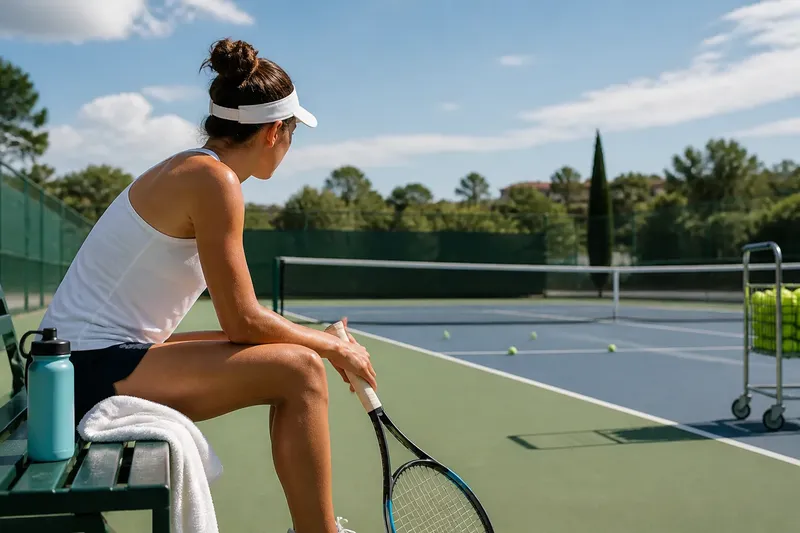
Say you are practising a tennis serve and the ball repeatedly sails long. After one attempt, you lower the racquet and take a breath. You recall that your contact point drifted forward, so on the next serve you focus on meeting the ball in front of your body. The result to notice is whether the contact point becomes easier to recognise, not whether the serve is perfect.
Why does the pause turn into a long break?
A pause can lose its purpose if you reach for your phone, begin another task or start judging the whole session. What began as time to register an attempt becomes time away from the task, and restarting can feel like beginning from scratch.
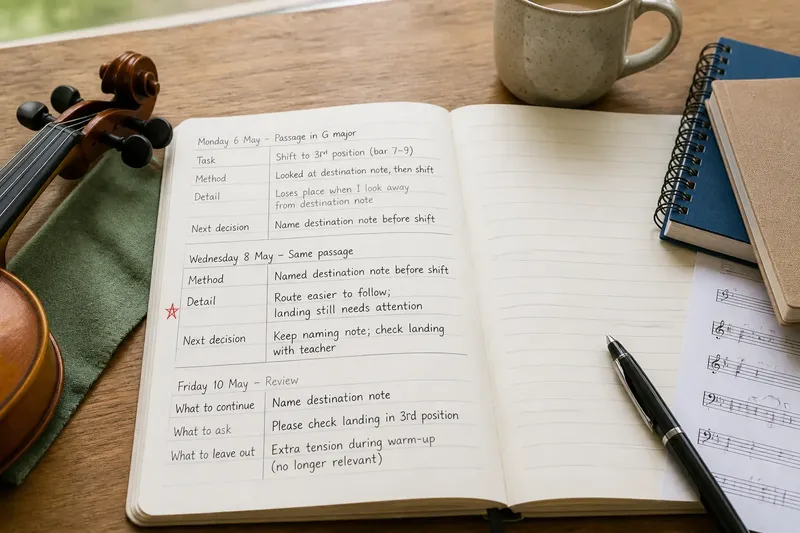
Give the pause a simple boundary. Put your phone out of reach, stay near your materials and use one short cue to mark what you noticed. You might write “shoulders rise before the catch” on a scrap of paper or say it quietly to yourself. Then return while the next action still feels available.
Keep the note brief. A practice pause does not need to become a diary, a technical analysis or a verdict on your ability. If the same observation is already clear, carry it into the next repetition without recording it again.
Why do I notice too many things at once?
After an attempt, it is tempting to inspect posture, timing, breathing, grip and outcome all at once. That can make the next repetition feel like a collection of corrections rather than one coordinated action. It also makes it hard to tell which adjustment changed the experience.
Choose one feature that you can directly observe and that seems relevant to the snag. For a drawing exercise, it might be whether your wrist lifts at the end of a line. For a dance turn, it might be whether your eyes settle on a point before your body rotates. Let other details wait for another round.
If you cannot identify a useful feature, do not invent a correction just to fill the pause. Ask where in the attempt the task started to feel uncertain. If the answer remains unclear, repeat the task at an easier pace or smaller scale, then pause and notice what becomes more apparent.
Why does the pause make me overthink?
Some people use the gap to replay an attempt in detail, criticise themselves or predict the next failure. That kind of mental review can crowd out the practical information a pause is meant to make visible. You may return to the task more tense, not more prepared.
Keep your observation neutral and specific. Replace “I always ruin the ending” with “I shortened the final note.” Replace “I am clumsy” with “I lost my balance when I turned.” The wording points towards something you can attend to without turning one attempt into a judgement about your ability.
Then choose a modest intention for the next try: “Keep the final note steady,” or “Notice where my weight shifts.” You do not need to predict how well it will go. The pause has done its job if it gives you one clear point of attention.
When should I pause, and when should I keep going?
Not every repetition needs a deliberate stop. A pause is useful when it helps you register an attempt, recover attention or decide what comes next. If the task is flowing and each repetition feels meaningfully different, stopping after every one may interrupt useful continuity.
Try pausing after a repetition that surprised you, after a clear error, or when you realise you are moving without attending. For a familiar passage or a sequence that depends on rhythm, you may prefer to complete a short run before stopping. Choose a point where you can still recall what happened.
Use this quick check to decide what to do next:
- Check whether you can name a specific moment in the attempt. If you can, carry that observation into the next try; if you cannot, slow down or simplify the task before repeating it.
- Check whether a clear error interrupted the task. If it did, pause and choose one feature to attend to; if it did not, continue for a short run when the rhythm matters.
- Check whether your attention is wandering. If it is, take a brief pause away from distractions; if it is steady, keep practising without forcing a stop.
- Check whether your movement feels less controlled. If it does, stop and rest rather than pushing through; if it does not, continue at a manageable pace.
- Check whether discomfort is growing. If it is, stop or change the activity and seek qualified advice when an injury or health concern calls for it; if it is not, choose the next attempt based on what you noticed.
- Check whether you are recording the same observation repeatedly. If you are, stop writing and use the cue; if the detail is hard to retain across a session, keep one brief note.
A pause between attempts is not a substitute for rest when you are tired or in pain. Stop or change the activity if needed, and seek qualified advice when an injury or other health concern calls for it.
What should I know about a rest between practice attempts?
How long should a rest between practice attempts last?
Pause long enough to recall one detail and choose an intention for the next repetition. Once you know what matters, return without waiting for a fixed interval.
Should I review video after every attempt?
Start with what you noticed yourself; checking video after every repetition can draw attention away from the feel and timing of the task. Review a recording when a specific question remains, rather than using it automatically after each try.
Is a pause useful when an attempt goes well?
Yes, if you can identify what helped, such as keeping your balance through a turn or holding a steady pace. Naming that feature can give the next attempt a deliberate focus without encouraging mindless repetition.
What if I cannot remember the attempt?
Make the next repetition simpler or slower, then pause immediately afterwards and notice one event. If recall remains vague, focus on a single moment rather than trying to reconstruct the whole performance.
What is not worth the effort?
You do not need a timer, a detailed scorecard or a perfect account of every repetition. Those tools can become another task to manage, especially when a plain pause and a few words will do. Use a note only when it helps you retain a useful observation across a session.
Also resist the urge to treat every pause as a chance to redesign your technique. Sometimes the best next attempt is simply another try with one point of attention. If that point stops being useful, choose a different one rather than piling corrections on top of it.
How can I make the next repetition more deliberate?
Imagine you are practising a short piano phrase and the last note keeps coming out too short. You finish one attempt, rest your hands, and identify the final note as the moment to watch. On the next attempt, you focus only on letting that note ring; afterwards, you listen for whether it lasts longer. If you still cannot tell, slow the phrase and repeat it, accepting that the slower pace trades musical flow for a clearer view of the ending.
Keep the cycle flexible: attempt, notice, choose, repeat. A rest between practice attempts is useful when it changes what you attend to, not merely when it adds time between repetitions. If you finish with a clearer sense of what to look for, the pause has given the next attempt a practical focus, even if the movement still needs work.