The Perfect Routine Myth: Why Practice Need Not Happen at the Same Hour
A practice routine does not need a fixed hour. Build a dependable cue around an ordinary event so learning can continue when your schedule shifts.
Your guitar lesson ends, dinner runs late, and the hour you usually practise has vanished. A practice routine can still work without a fixed time if you connect it to a repeatable event or place.
A regular hour suits some people, but it is not essential. The useful question is whether the prompt for practice still appears when your day changes—and whether you can act on it without negotiating with yourself all over again.
Does a practice routine need to happen at the same time every day?
No: a fixed hour is one way to remember, not a requirement for a useful routine. If your schedule varies, insisting on the same slot can turn practice into a daily scheduling problem.
Instead, connect practice to something you already do, such as making tea, arriving at the community centre or putting your work bag away. The event can recur even if the hour changes.
This is different from practising whenever you happen to remember. A routine has a prompt chosen in advance, an activity you can begin, and a sensible alternative for occasions when the usual conditions are missing.
What makes a practice cue dependable?
Choose an event or place you encounter regularly and can usually act on. A cue is less dependable if it relies on another person’s unpredictable schedule or a room that is often unavailable.
Make the plan concrete: “After breakfast, I review my Spanish cards at the kitchen table” gives you a prompt, an activity and a location. “I’ll study when I have time” leaves you to decide repeatedly whether the moment has arrived.
Your surroundings can help without becoming a rule. A sketchbook beside the chair where you unwind may make drawing easier to remember; you can still draw elsewhere when that corner is occupied.
How can you adapt practice when your schedule changes?
Decide in advance on a full version and a smaller version of the same activity. Keep the smaller option focused enough to be useful, but easy to fit into a disrupted day. You do not need to make up for it later unless you genuinely have the time and energy.
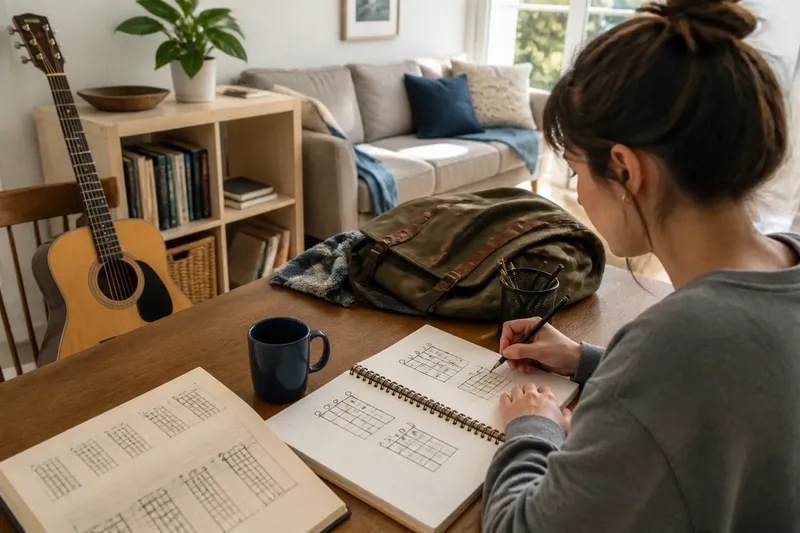
Say you usually practise guitar after putting away dinner, but guests arrive before you can take out the instrument. Your full plan is to play through a chord passage; your alternative is to sketch the chord shapes from memory in a notebook before bed. You open the notebook, draw the shapes and compare them with your notes. The visible result is that you have revisited the material, though you have not practised playing it; that trade-off is clear rather than disguised as a full session.
What is not worth the effort is building a long chain of backup plans for every possible interruption. Choose one straightforward alternative and return to the usual routine when its cue is available again.
What should you do when you miss your usual cue?
Resume at the next useful opportunity instead of treating one missed session as proof that the routine has failed. Check what got in the way: perhaps the cue did not happen, the space was unavailable, or the planned activity was too demanding at that time.
If the same obstacle keeps recurring, change the part that is causing trouble. Someone whose evenings are regularly crowded might link a short review to a lunch break or to arriving at a library. The best cue is the one that fits the day they actually have.
Avoid trying to repay a missed session by cramming practice into a tired or unsuitable moment. Treating practice as a debt can make it harder to return; use the next workable cue instead.
Which practice cue fits your day?
Is a time-based reminder still useful?
Yes, if a regular hour fits your day. A calendar alert can prompt you to begin, without making every other time invalid.
Can I use a place as my cue?
Yes, if you visit the place regularly and can use it for your activity. Decide what you will practise before arriving at a library desk, rehearsal room or quiet corner.
What if my days are unpredictable?
Choose an event that occurs across different kinds of day, such as unpacking your bag after coming home. Keep one short version ready for times when your usual space or session is unavailable.
How can I tell whether the cue is useful?
Notice whether it helps you begin without a fresh debate. If you often overlook it or cannot act on it, change the prompt, location or activity rather than blaming yourself.
What should you check before choosing a practice cue?
- Check whether the event happens on the days you hope to practise; if it does, use it as the main cue, and if it does not, choose a more frequent event.
- Check whether you can reach the practice space after the cue; if it is usually available, link the activity to that place, and if it is often occupied, choose a backup location.
- Check whether the activity is clear enough to start without extra planning; if you know what to do, keep it, and if not, name one specific task before the cue arrives.
- Check whether the full session fits the time and energy you commonly have; if it does, keep it as the main version, and if it does not, prepare a smaller focused alternative.
- Check whether the cue depends on someone else’s changing plans; if it is under your control, keep it, and if it is not, use an event you can manage yourself.
- Check whether you can recognise that you began, such as opening the score or completing a vocabulary review; if the result is visible, keep the activity, and if it is not, make the task more specific.
For example, imagine that Mira wants to practise guitar, but dinner happens at different times and the living room is sometimes occupied. She checks that putting away her work bag happens when she gets home, that the guitar can be moved to a quiet corner, and that playing one chord passage is a clear main task. She sets the bag-down event as her cue and chooses drawing the passage’s chord shapes from memory as her shorter alternative. On a busy evening, she draws the shapes and checks them against her notebook: she has reviewed the material, but not played it. That gives her a clear choice about what counts as a full session and what is only the fallback.
To set up a practice routine today, choose an event you can recognise, pair it with a specific activity, and name one realistic alternative for a disrupted day. Keep the plan somewhere you will see it, such as beside a music stand or notebook. A useful routine can move with the clock while still making the next action clear.