From Copybooks to Practice Logs: A Short History of Recording Repetition
Practice logs preserve the process behind repeated work, helping you track what you tried and changed and decide what to revisit next.
A learner opens a copybook, finds a row of carefully copied letters and sees a teacher’s mark beside one line. That small scene connects old forms of practice recording with today’s practice logs: both can help someone pick up a task again without relying on memory alone.
What did copybooks record?
Copybooks were used to practise handwriting by copying letters, words or passages from a model. The page preserved the exercise and its order; repeated lines made visible differences in letter shape and spacing. Those marks could prompt a teacher or learner to look more closely, though they could not explain the reason for every variation.
A tidy line might take considerable effort, while a smudge might come from the writing surface or an awkward desk. The page showed what had been made, not the learner’s full experience. That distinction still matters: a record can support reflection without becoming a verdict on ability.
How did written practice records develop?
There is no single, simple history of the practice log. Different records served different purposes: a copybook held repeated writing, a workshop notebook could preserve working notes, and a musician’s marked score could identify a passage to revisit. These examples describe forms of recording, rather than a universal timeline in which one method replaced another.
Printed exercise books offered a prepared place for tasks and written responses. Personal diaries and notebooks offered a more flexible alternative: a learner could note a passage, a question or a point to return to. The tools did not capture skill itself. They made it easier to carry a reminder from one session to another.
Today, a paper notebook, spreadsheet or notes app can do much the same job. Choose a format that is easy to reopen and scan; the useful record is the one that helps you resume the work.
What should a practice log help you decide?
Give each entry a practical purpose: help you choose what to revisit, what to ask, or what to leave unchanged. A note such as “the shift into the next position became hard to follow after I looked away from the destination note” identifies a point to examine. A label such as “hopeless” gives you no useful choice.
- Task: If you can name the passage, movement or drill, then return to that specific task; if you cannot, write a clearer label before the next session.
- Method: If the note names an approach, such as marking a cue or changing the order, then decide whether to repeat it; if no approach is recorded, write down the one you choose next.
- Visible or felt detail: If you can locate what changed or became unclear, then revisit that point; if the note is only a judgement, replace it with a description.
- Next action: If the entry names a manageable action, then begin there next time; if it does not, choose one action or leave the task for a teacher or coach to clarify.
- Open question: If a question remains unresolved, then take it to a teacher or coach when appropriate; if it is already answered by your instructions, use those instructions instead.
- Usefulness: If a detail will change what you revisit or ask, keep it; if it will not affect a future decision, leave it out.
Keep the record descriptive rather than trying to score your whole session. The aim is to make a later choice easier, not to produce a complete account of every repetition.
How can you review a practice log?
At the end of a session, read the latest entry and decide what it asks you to do next. During a weekly review, compare only the notes that relate to the same task. Look for a useful decision: repeat a method, change it, ask someone for help or stop recording a detail that no longer affects your work.
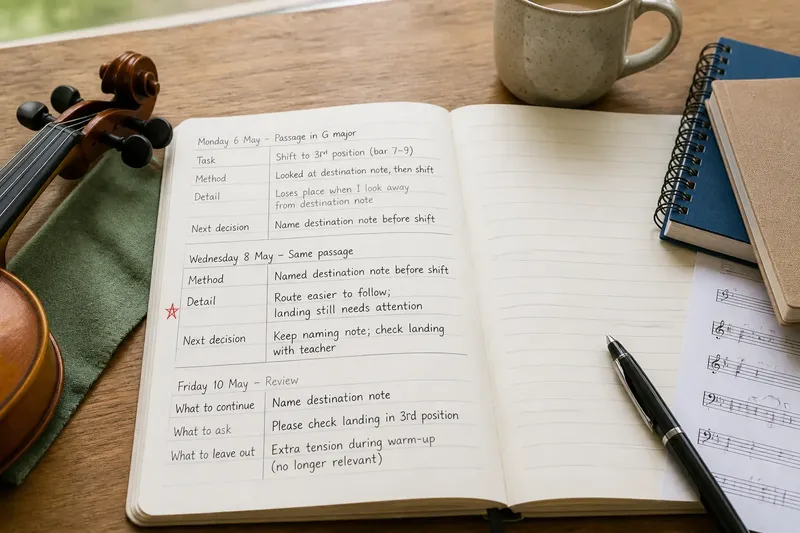
Say you are learning a short passage on the violin. On Monday, you write, “The shift into the new position loses its place when I look away from the destination note.” On Wednesday, you note, “Naming the destination note before the shift made the route easier to follow; the landing still needs attention.” On Friday, you compare the entries and decide to keep naming the note, then ask your teacher to check the landing. The record has helped you choose what to continue and what to ask, without rating your ability.
It is not worth the effort to decorate every entry, record every repetition or create scores that do not answer a real question. If paperwork starts taking attention away from practice, shorten the entry to the task and the decision you need to make.
What do learners ask about practice logs?
What belongs in a practice log?
Write the task, the method you used, a relevant detail and the next decision. If one of those would not help you resume or ask a useful question, leave it out.
How often should you update a practice log?
Add a note when it will help you make a later choice, such as revisiting a task or asking for clarification. A regular review can connect entries, but a daily record is not required.
Should a practice log include scores?
Use a score only when it serves a clear purpose and you know what it represents. Otherwise, describe the task and the decision it calls for.
What if progress feels hard to see?
Review whether your notes help you choose a next action or ask a more precise question. If they do not, simplify the format and record only details that affect your next decision.
A practice log is most useful when it leaves you with a clear choice about what to revisit, change or ask. Keep the record small enough to use, and let the next session—not the neatness of the page—show whether it is serving your learning.