A First Rehearsal in a Shared Room: Leave Space for Listening
A first group rehearsal can establish a shared starting point, make room for each person’s sound and leave the group with one clear note for next time.
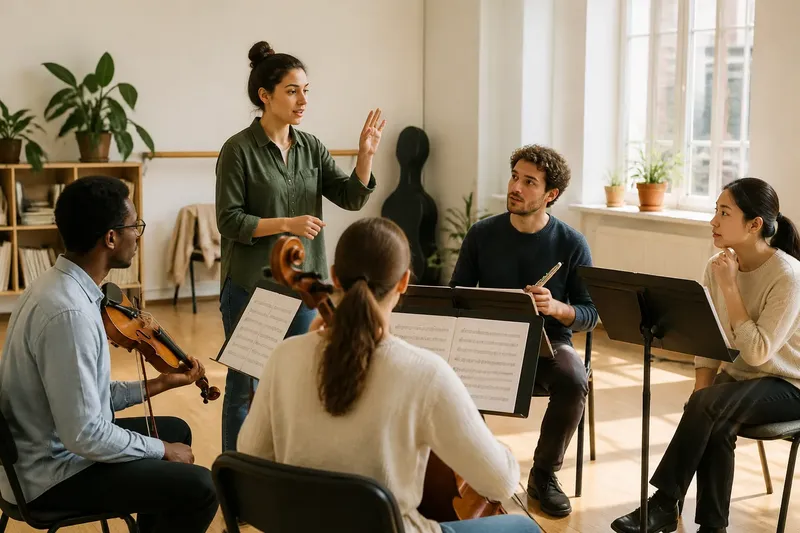
At a first group rehearsal, one person is still moving a music stand while another asks where to begin. Before anyone plays, the group can agree on a simple opening that helps everyone hear and respond. A first group rehearsal becomes easier to join when people know what they are starting, who will cue them and what to listen for.
That agreement need not turn the session into a meeting. The group might begin together, take turns with a short passage or follow a leader’s cue. Each option gives people a different way to hear one another, so choose according to what feels uncertain: the starting point, the individual contributions or the transitions.
What should the group settle before playing?
Agree on the opening activity, its starting point, who gives the cue and one audible or visible feature to notice. For a music group, that could be a marked phrase and the melody’s entrance. For a movement ensemble, it might be a starting shape and a shared change of direction.
Check that everyone can see the cue and hear the parts that matter. If a chair or music stand blocks someone’s view, move it before beginning. Keep any stop signal distinct from the cue to start; a raised hand, for instance, can mean pause and return to the agreed point.
Which opening approach fits the group?
Choose one approach for the first activity. The aim is not to find a perfect format, but to make the group’s immediate task clear.
Would a shared start help?
Begin together when people need a common reference for timing or direction. Give one cue and listen for a feature such as a steady pulse, a clear entrance or a coordinated turn. If individual contributions are hard to hear, avoid repeating the whole passage at full volume; let a smaller section take its turn instead.
Would taking turns help?
Let one person or section perform a short passage while the others listen for a specific detail, then rotate. This can make a quieter part or idea easier to notice. If the group already coordinates comfortably, keep the turns brief so the activity does not interrupt its shared flow.
Would a leader’s cue help?
Ask one person to give a visible or audible signal when entrances or transitions are confusing. The group then listens for what follows the cue, rather than treating it as a command to rush. If others have observations, leave space for them before the leader decides what to try next.
Say a newly formed ensemble is unsure whether its quieter parts can be heard. It begins with a short shared phrase, then has each section play that phrase alone while the others listen for its entrance. The group can then identify which entrance was easy to hear and which was not, and decide whether to change the layout or cue before attempting the phrase together again.
How can the group choose what to try?
Match the approach to the uncertainty. If people do not know where or when to begin, use a shared start. If they cannot distinguish contributions, take turns. If transitions are unclear, try a leader’s cue. The first activity may reveal a different need, so the group can change its approach without treating the initial choice as a failure.
Give people a precise listening task. “Listen better” is hard to act on; “notice whether the second voice enters after the first phrase” names an event. For movement, ask whether the group changes direction together rather than whether the movement looks polished.
Invite observations before suggestions. “I heard the lower part after the melody began” describes a moment; “you should be louder” jumps to a fix that may not suit the room. Let the person concerned respond, then decide whether a change is useful.
It is not worth stopping after every small variation to debate who caused it. If the group loses its place, use the agreed stop signal and return to the starting point. Keep the discussion on what the group can hear or see and what would help it continue.
What should the group do after the first attempt?
Give everyone a chance to describe one thing they heard or noticed, tied to a particular moment. If people noticed different things, use that difference to choose the next activity: take turns if a contribution was hard to distinguish, or clarify the cue if people missed the transition.
Then choose the next arrangement together. The options might be to move a chair, change who gives the cue, let one section play alone or return to the passage at a slower pace. Say what the group will listen for in that arrangement, so people know what evidence will help them decide whether it suits the task.
After the next pass, decide whether the arrangement made the feature easier to notice. If it did, continue with the activity or move on. If it did not, try a different arrangement that addresses the same uncertainty rather than changing several things at once.
What should go in the note for next time?
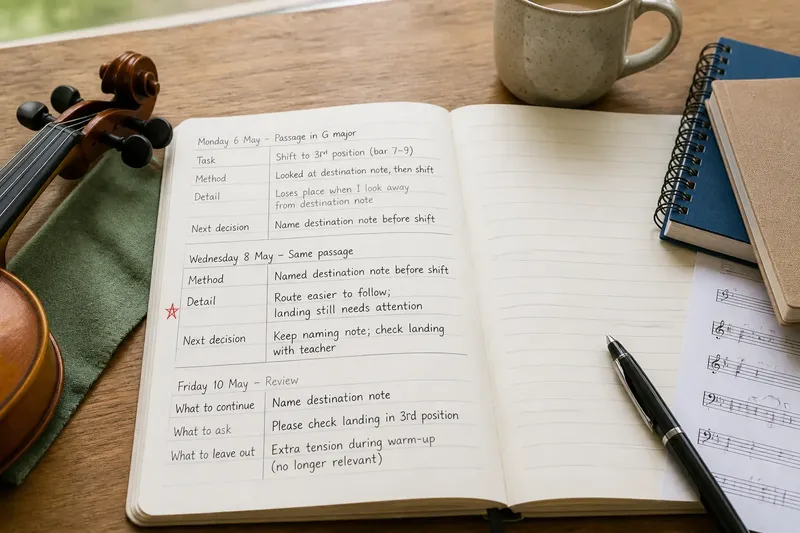
Record the group’s agreed starting point, cue and next listening question on a shared sheet, in a message thread or in the music folder. Keep the note focused on the plan rather than on who caused a difficulty.
For example: “Start at the second phrase; use the visible hand cue; listen for the lower part’s entrance.” If the group could not hear the cue clearly, write what it will try next, such as “face the group when giving the entrance cue”. Ask everyone to confirm that the note matches the decision before ending.
What questions come up before a first group rehearsal?
How long should the opening activity last?
Continue until the group has tried its listening task and can decide what to do next. Move on if the task is clear or the current approach is not helping; there is no need to repeat it merely to fill time.
Who should lead the first attempt?
Choose the person who can give the clearest cue for that activity, not automatically the most experienced person. The role can change if another activity needs a different kind of signal.
What if nobody knows what to say?
Ask about a specific audible or visible event, such as where an entrance occurred or whether the group changed direction together. A narrow prompt gives people something concrete to describe.
Should the group record the rehearsal?
Record only if it serves a clear purpose and everyone agrees. A short written note may be enough; if recording would distract people from listening to one another, leave it aside.
A first group rehearsal does not need to settle every artistic choice. Agree on the starting point, choose an approach that fits the group’s immediate uncertainty and record the next listening task. That way, the next first group rehearsal can begin with a shared plan rather than another search for where to start.